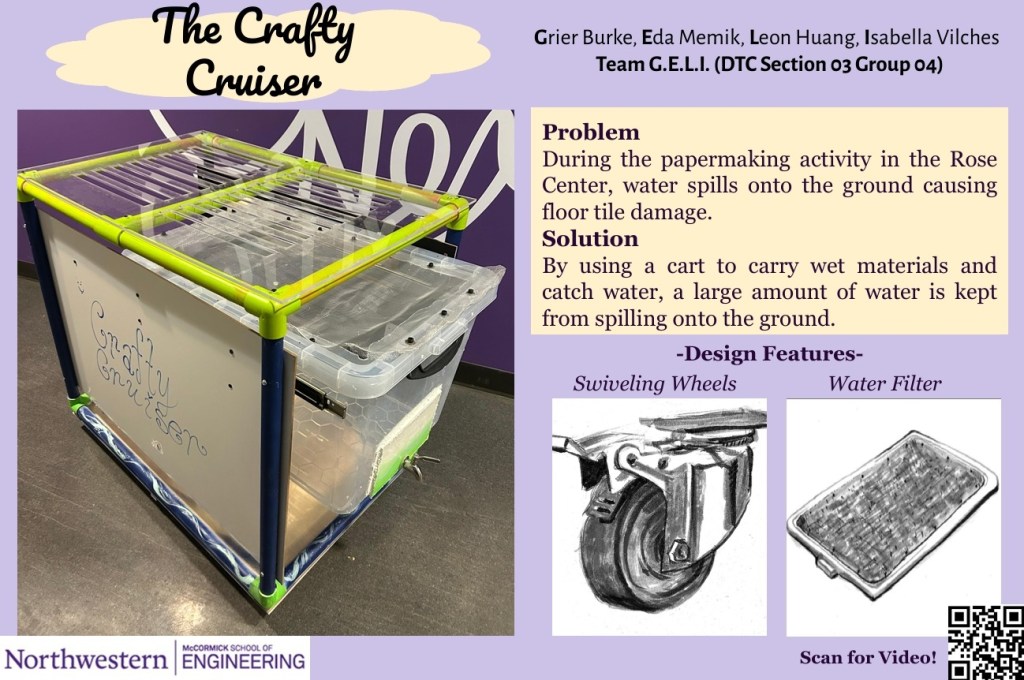
Through the partnership with the Envision Unlimited rose center, and the design project to fix their water spillage issue, I have learned an incredible amount. One part of the learning was about the physical processes of a design project; I learned how to acquire the proper materials, construct a prototype, and work together as a team to solve problems. However, another huge part of the experience I gained from this project was through the final report that outlines the final prototype.
My skills were tested in a few key areas throughout the project, namely my ability to work with others effectively. My team cordoned off sections of the document for each person to focus on. As the deadline approached we went through other peoples’ sections and made a more uniform document. One strategy we came up with was highlighting different headers of the document with different colors that represent each member of the group. Additionally, we did not really have a strict leadership structure, and put out a list of what we had to do any given week and took responsibility for roughly equal numbers of the assignments. We also were open about what we were most informed about. For example, since I went to the Rose Center in person, I was the one who wrote about the user observation results. Overall despite this being my first time working in a team for a long term project, I now have a good understanding of what effective team cohesion looks like. Most of the problems we came across occurred during the building of the prototype, where we had to diverge slightly from our original ideas. One issue was when we realized that the original honeycomb design for the grates on top of our cart would not be feasible; this was due to the laser cutter not being very fast, and the pattern being quite complicated. And so, we simply agreed as a team to change the design. Later on, we also realized that the top of the cart would need more support, so we added a supporting bar to the middle. When we came across a problem we figured out a way to address it, especially when translating our idea from paper to PVC piping, acrylic, and wood.
The report itself was also an integral part of my learning. I have never written a design summary like this before, and I have realized so much about the mechanics of making such a document. Not only is the focus of writing the design report to make it informative, but it should also be easy to skim through. It had to give the option for someone not very familiar with the subject to learn; it also had to engage someone who already was aware of what the paper was talking about. This was done through specific formatting techniques that pull someone’s attention while they are skimming through the document. Using lists and bulleted points can be an effective way to quickly get information across while also cutting out unnecessary additions and reducing crowding on a page. A variety of header types can also help someone find exactly what they need in a document. Images and charts are also very effective in breaking up large blocks of text; otherwise it could be more difficult for an audience that is not looking for a deep explanation of a topic to get through the entire document.
When it comes to improving the document, the team had many opportunities to get feedback and commentary from those around us. When we had around half of our final document finished, we had a review session with our professors. Prof. Fischer helped us get our document into a much better shape as she taught us the mechanics of writing a professional design document, and helped us arrange the elements of our final report. When it comes to the visual representations of our project Prof. Kiamanesh, taught us about the specific techniques that engineers use to draw their designs. Both of our professors gave us the information that we needed to learn, so that we knew exactly how a design document should be done. Our peers on the other hand also helped us in getting a better document. I remember reading through another team’s assignment and I feel that it helped me be more critical in what I should be looking for in my own team’s report. I recognized a few long and wordy sentences, and at the same time some formatting discrepancies. Being able to see how another team made their report was also very helpful. By looking at the other team’s document, I was reminded to remove the indentations on all the paragraphs and align all them so that they looked even on the sides. When it comes to the comments by my peers, I read that we referred to ourselves too many times in some sections of the paper, so I worked to remove those mentions. Overall, this project took a lot of dedication and hard work, not only in the report itself but also to build the physical design and the team that could pull it off.
This is an example of a page. Unlike posts, which are displayed on your blog’s front page in the order they’re published, pages are better suited for more timeless content that you want to be easily accessible, like your About or Contact information. Click the Edit link to make changes to this page or add another page.
 Eda DTC Portfolio, work in progress